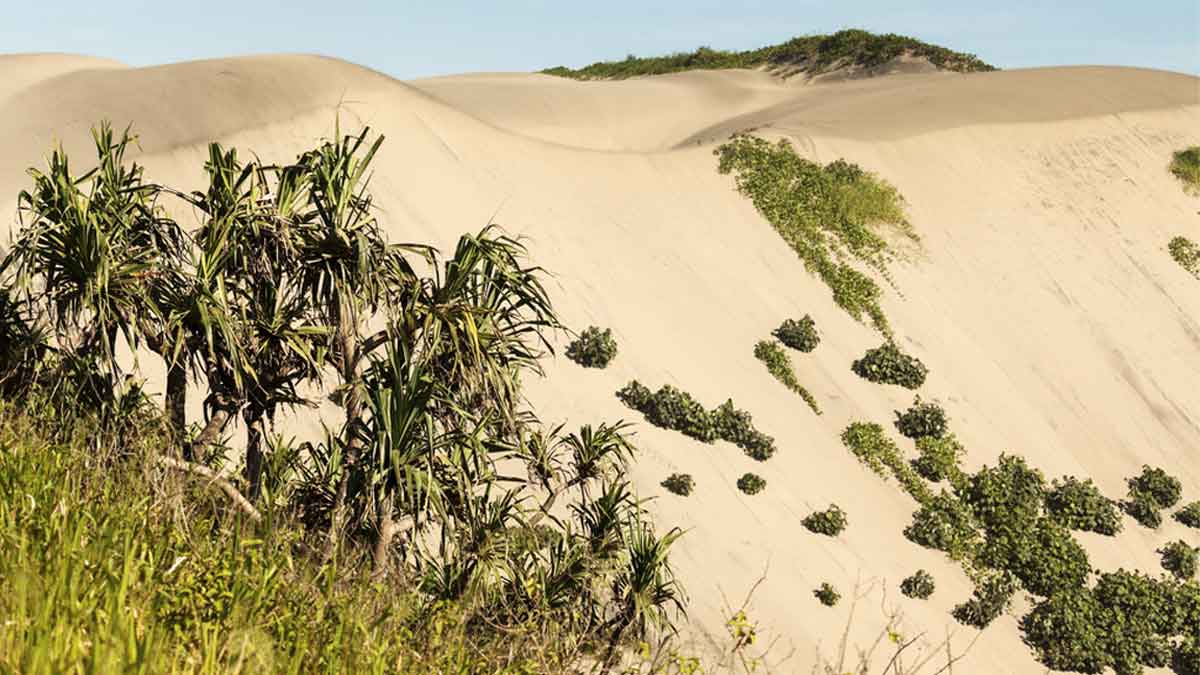
An urgent call is being made by the Fiji Museum to halt the proposed Sigatoka Iron Sands Mining Project to ensure that they are provided with adequate time to review the impact on irreplaceable cultural, archaeological and palaeontological resources that the mining of magnetite iron sands at the mouth of the Sigatoka River, beside the Sigatoka Sand Dunes would allow.
In a letter to the Minister for Environment Lynda Tabuya and Minister for Multi Ethnic Affairs Charan Jeath Singh, Fiji Museum CEO Armando Lowe says the matter is now pressing, adding the Environmental Impact Assessment for the project by Magma Mines Pte Ltd was placed for public review on 2nd October, and submissions close on Friday.
He says the company has told its investors that its feasibility study is in its final stage and that it is moving to obtain a Mining Lease, adding that once this window closes, a decision with irreversible consequences for Fiji’s heritage could follow quickly.
Lowe says the licence boundary excludes the National Park itself, but that offers little real protection.
He says the archaeological deposits of the dunes do not stop at the park fence; the National Park covers only around half of the dune system, and the richest archaeology lies at the eastern end of the dunes, closest to the river mouth and the licence area.
The Museum CEO says landowners of the Tikina o Nasigatoka have already appealed to the Prime Minister to cancel special prospecting licence, citing its proximity to the protected dunes and to the Fiji Museum’s archaeological site.
Lowe says he is also concerned that the EIA has been made available only in hard copy at four locations, with no online copy, giving the public, the vanua and heritage institutions very limited opportunity to scrutinise a proposal of this scale.
Highlighting the importance of the Sigatoka Sand Dunes matter to Fiji and to the world, Lowe says the Sigatoka Sand Dunes have been on the UNESCO World Heritage Tentative List since 26th October 1999, in the cultural category under criteria (iii), (iv) and (v), nominated through the National Trust of Fiji.
He says Levuka remains Fiji’s only inscribed World Heritage property; Sigatoka is one of the strongest candidates to become our second.
The CEO says approving industrial mining beside a Tentative List site would seriously damage that prospect and Fiji’s standing as a State Party to the World Heritage Convention.
Lowe further says the dunes are one of Fiji’s earliest recorded prehistoric sites, with cultural layers dating back about 3,000 years, and have produced the largest collection of complete and near-complete Lapita pottery found anywhere in the Pacific.
He says the site is central to understanding how people first settled the remote Pacific, with the archaeological findings serving as a reference for Fijian prehistory for more than three decades.
Lowe also highlights the significance of the dunes as an ancient burial ground, with more than 119 individuals excavated by 1998, and says human remains continue to emerge from the sand through natural processes.
He says disturbing or destroying these burial sites would breach the vanua’s relationship with its ancestors and Fiji’s national obligations to protect its heritage.
Lowe warns that large-scale sand extraction from the Sigatoka River, Koroua Island and the delta could deprive the dunes of the sediment that sustains them, accelerating erosion and exposing burials and archaeological deposits across the dune system.
He says the dunes became Fiji’s first National Park in 1989 and are home to more than 37 bird species, including eight endemic to Fiji, as well as a rare tropical dune forest.
He adds that the area is also an important tourism asset, attracting local and international visitors and supporting the Coral Coast’s tourism industry, education and local livelihoods.
Lowe says the Fiji Museum is legally responsible for protecting Fiji’s archaeological heritage under the Fiji Museum Act 1929 and the Preservation of Objects of Archaeological and Palaeontological Interest Act 1940.
He further says the Museum’s advice on the project has not been given the weight intended under the law and is urging Government to take its concerns into account.
Lowe says concerns have also been raised by landowners and the vanua of Nasigatoka, civil society organisations, including Caritas Fiji and the Fiji Council of Social Services, and members of the public.
He is calling on the Government to halt the project, extend the public review period beyond 30th October and publish the full Environmental Impact Assessment online.
He is also seeking an independent archaeological impact assessment by the Fiji Museum, an independent study of the effects of sand extraction on the dune system, and legal protection for the archaeological landscape, including adjoining land within the licence area.
Lowe further calls for the advancement of the site’s UNESCO World Heritage nomination and for the free, prior and informed consent of the vanua and landowning communities of Nasigatoka and Kulukulu.
He has also requested an urgent meeting with the Fiji Museum, the National Trust of Fiji and landowner representatives before next Friday.
Lowe says the Sigatoka Sand Dunes hold 3,000 years of Fiji’s history and the resting places of its ancestors, and urges the Government to protect them for the people of Fiji and the world.
Meanwhile, the Ministry of Environment and Climate Change says the EIA report was made available for public inspection from 2nd October, in accordance with the Environmental Management Act and the established EIA process.
Meanwhile, the Ministry of Environment and Climate Change says the EIA report was made available for public inspection from 2nd October, in accordance with the Environmental Management Act and the established EIA process.
The Ministry says the statutory 21-working-day public review period remains in effect and will conclude on Friday.
It says the timing of media notices does not determine or alter the legal review period, which began when the report was made available for public inspection.
The Ministry says the timing of public notices formed part of a deliberate communications strategy following Fiji’s hosting of Pre-COP31 engagements and the public holiday on 12th October.
It says its communication platforms were heavily dedicated to informing the public about Fiji’s leadership and participation in regional and international climate discussions during that period.
The Ministry says it intentionally scheduled the publication of the public notice during a subsequent news cycle to give the EIA review process greater prominence and encourage meaningful public participation, rather than risk the notice being overlooked amid extensive Pre-COP31 communications.
It maintains that all legislative and procedural requirements under the Environmental Management Act and the established EIA process have been met.
The Ministry says it has received seven electronic submissions, while attendance at the four designated public viewing locations has been relatively low.
It is encouraging members of the public, community groups, civil society organisations and other stakeholders to review the report and provide written submissions before Friday.
The Ministry also stresses that the submission of an EIA report does not constitute approval of the project, and no decision has been made on whether it will be approved.