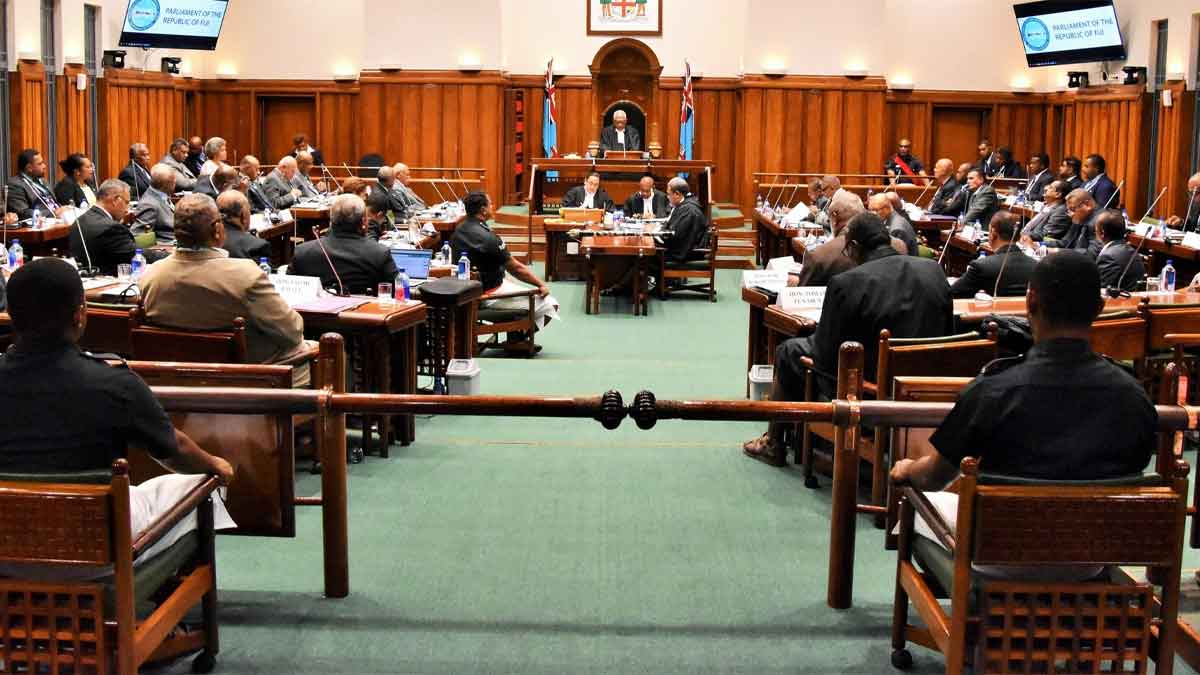
The Constitution Amendment Bill proposes the retention of a 55 member Parliament however a system is proposed where 33 constituency members or such number as Parliament may by written law prescribe, which includes 5 maritime constituencies chosen directly by the registered voters of those constituencies in a first-past-the-post election; and 22 party list members or such number as Parliament may by written law prescribe, allocated to political parties in proportion to the total number of votes for the candidates of that party in the constituency seats.
Parliament or the House of Representatives is to be composed in a manner that reflects, as closely as practicable, the proportion of votes cast for political parties.
A political party is entitled to proportional representation if it secures not less than 5 percent of the party vote.
Constituency seats won are deducted from each party’s proportional entitlement, with the balance filled from party lists.
The Party list seats must be allocated in accordance with a written law prescribing an appropriate mathematical rounding method, which rounds fractions to whole numbers to determine seat allocations.
Candidates unaffiliated with a political party may contest constituency seats, and if elected, serve as independent members without affecting proportional allocation.
A candidate of a party can stand for election in a constituency seat and be included in the party’s list for a party list seat.
Parliament may provide, by written law, for temporary special measures relating to the way in which party lists must be constituted, for example measures to ensure, as far as possible, equal numbers of male and female candidates; or measures to otherwise facilitate diverse representation on party lists.
The maritime constituencies are Rotuma, Yasawa, Kadavu, Lomaiviti and Lau.
A candidate for election to the House of Representatives must be either nominated by a registered political party or nominated as an independent candidate in accordance with the laws governing elections.
A person may be a candidate for election to the House of Representatives only if the person is a citizen of Fiji; is qualified to be registered as a voter and is registered on the Register of Voters; is ordinarily resident in Fiji for at least 2 years immediately before being nominated; is not an undischarged bankrupt; is not a member of the Electoral Commission and has not been a member of that Commission at any time during the 4 years immediately before being nominated; is not subject to a sentence of imprisonment when nominated; has not, at any time during the 8 years immediately before being nominated, been convicted of an offence under any law for which the maximum penalty is a term of imprisonment of 12 months or more; and has not, in the 5 years immediately before being nominated, been found guilty of any offence under a law relating to elections, registration of political parties or registration of voters.
The total number of candidates that a political party may nominate for any general election must not be more than the total number of seats in the House of Representatives, and the total number of candidates that a political party may nominate for any by-election must not be more than the total number of vacant seats in the House of Representatives for which the by-election is held.
If a seat in the House of Representatives becomes vacant, the vacancy must be filled in the case of a constituency seat, by a by-election; and in the case of a party list seat, by the next candidate on the party list; or if there is no next candidate on the party list, by a by-election.
The Bill also proposes the House of Representatives continues for 5 years from the date of its firstmeeting after a general election of the members of the House of Representatives, unless
sooner dissolved in accordance with the Constitution.