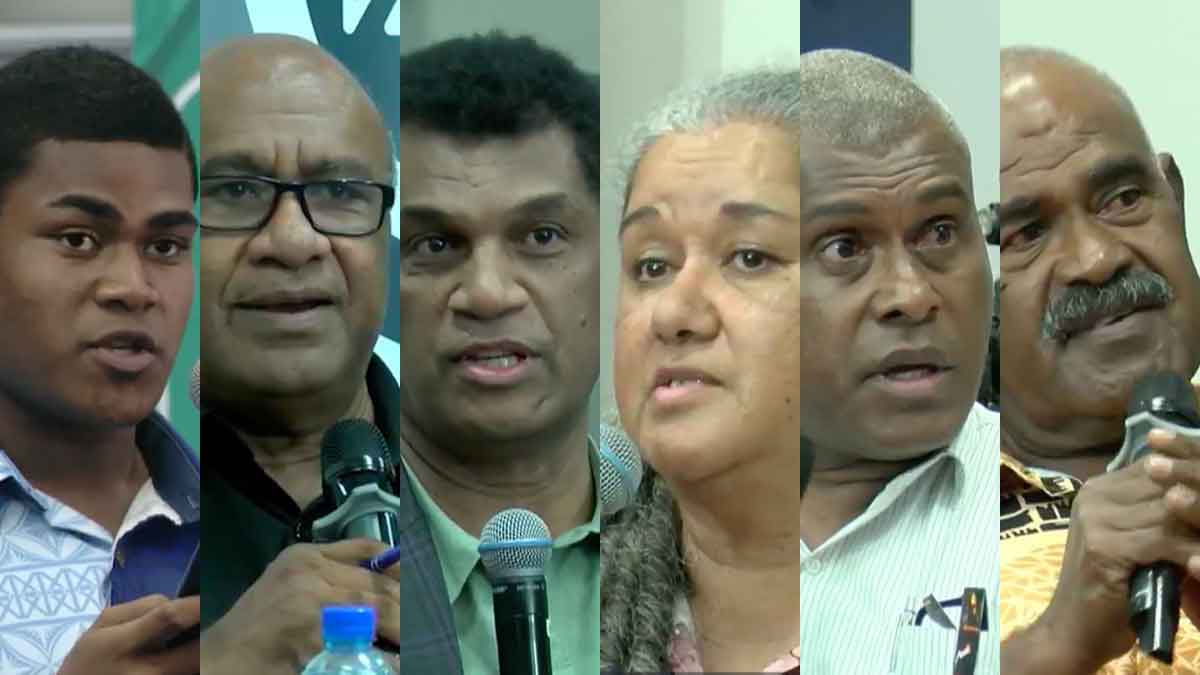
A Year 11 Votualevu College student is calling for the return of corporal punishment in schools, saying it could help address student indiscipline and protect teachers, while also questioning whether Government should bring back the Year 10 external examination and strengthen the repeat policy.
Sailasa Seavula raised these questions during the Fijian Media Association Town Hall Forum in Nadi at FNU Namaka Campus, saying education plays an important role in shaping the future of young people and that some areas need serious attention.
Seavula says examinations can encourage students to take studies seriously, prepare themselves for higher-level education and understand their academic progress.
On the repeat policy, he questions whether Government could strengthen the existing policy in secondary schools, saying some students move to the next year level without fully understanding the subjects they have been taught.
He gives the example of a student who struggles with basic English and may find it difficult to cope with Year 12, saying stronger academic support and clear standards are needed to help students improve.
Referring to a video circulating on social media showing a student damaging school facilities, he asks what Government would do to maintain the level of discipline in schools and whether it would continue issuing warnings and suspending students.
He says they have to bring back corporal punishment so students can learn how school works and do not damage school facilities.
Seavula also says teachers' boundaries are not being respected and that corporal punishment should return so students and teachers are protected.
In response, Minister for Education Aseri Radrodro says the Ministry of Education Act has expanded the Ministry's jurisdiction beyond the school environment.
Radrodro says the new Education Act 2026 empowers Ministry staff and teachers to come to students' homes, villages and communities and inquire with parents and guardians why students are not attending school or are misbehaving.
He says the new Act also covers teacher protection, including issues of bullying and student misconduct.
Radrodro says the new Education Act will be effective from 1st January, 2027.
Meanwhile, NextGen Alliance Party Deputy Leader Noeleen Billings says parents need to take greater responsibility for their children's behaviour.
She says she would like to see more parents being more responsible for their children, especially from a young age.
Billings says she would rather see parents brought into schools and asked why their children are behaving in a particular way, adding that parents should be disciplined more because they are getting away with their responsibilities.
Responding to her comments, Seavula says some students or children, after being disciplined at home, take it to the police.
Billings says children should learn manners from an early age and suggests the education system introduce more lessons on manners from Class One and Class Two.
She says it is very unfair to just blame the child because the child is doing that for a reason.
Billings also says more parents are too caught up on their phones or sitting around the grog bowl than worrying about sitting and helping their children with homework.
Drawing on her experience as a former teacher, she says she never had to punish any of her students and that it is also the way a teacher approaches a student.
She says teachers should look into a child's background, sit with the child and spend more time asking what the problem is.
Billings says the classroom is the place to make errors and teachers are not being paid to discipline children, but to teach them the lessons they came to learn.
She says children should already know discipline before they get to school.
Liberation of Fiji Party representative Veronica Malani says there should be an integrated approach between parents, teachers and elders in society.
Malani says the Ministry of Education should conduct some psychological assessment or survey to understand the factors determining a child's behaviour, followed by consultations with parents, churches and community leaders.
She says Fiji could look at international communities that have gone through the same process and maybe amend the law so that it can at least have a bit of capital punishment.
Malani also says some students may be suffering from autism or some behavioural symptoms and says her party would pursue the proposed approach.
We Unite Fiji Party Leader Ruveni Nadalo says changes to the education system should begin from early childhood.
He says children should learn their culture and language from early childhood to Class Three, because by the time they reach Class Four, it is still intact with them.
Nadalo says children are beyond control from a very young age and that the whole education system needs to change from early childhood.
Kingdom Unite All People's Party representative Ratu Manoa Sova says the issue is about morality and humanity and questions how Christian beliefs and other religious doctrines are being applied when disciplining children.
Sova says corporal punishment was part of the upbringing of many people in Fiji and questions why Fiji cannot think for itself and decide what is best for its people.
He says he advocates corporal punishment at home and leaving schools to have their own disciplinary measures.
Also responding to the Year 11 student, National Federation Party Leader Professor Biman Prasad says corporal punishment should not be advocated in schools or at home.
He says issues such as screen time, the use of social media and values education are ways in which student behaviour can be addressed.
Professor Prasad says there are more decent, tested and internationally recognised alternatives to deal with indiscipline and how students behave in classrooms.
He also says students in schools should have this debate and refers to the Education Commission report, which he says is going to Cabinet.
Deputy Prime Minister Manoa Kamikamica says corporal punishment is a significant issue in Fiji and refers to the Constitution's inclusion on moderate chastisement.
Kamikamica says he has been moving around the country and listening to teachers, recalling a forum where two female teachers cried when they spoke about how insecure they felt entering their classrooms because of the way students treated them.
He says it is fine to say to deal with the parents, but questions how Government reaches in and tries to educate parents.
He says it is a national issue and people need to continue discussing it.
Kamikamica also shares his own experience of receiving corporal punishment as a child, saying he was a pretty naughty boy but by the time he got to high school, he was very respectful and knew what was right and wrong.
He says there may be some merit in corporal punishment, but it needs to be a national conversation.
He says the issue goes beyond corporal punishment and points to a social breakdown happening in the country, adding that the family unit is no longer functioning as a proper family unit.
Kamikamica says Government cannot fix a family problem, otherwise it would be involved in every single family in Fiji.
He says the country needs to discuss the major issues underlying student behaviour and discipline.