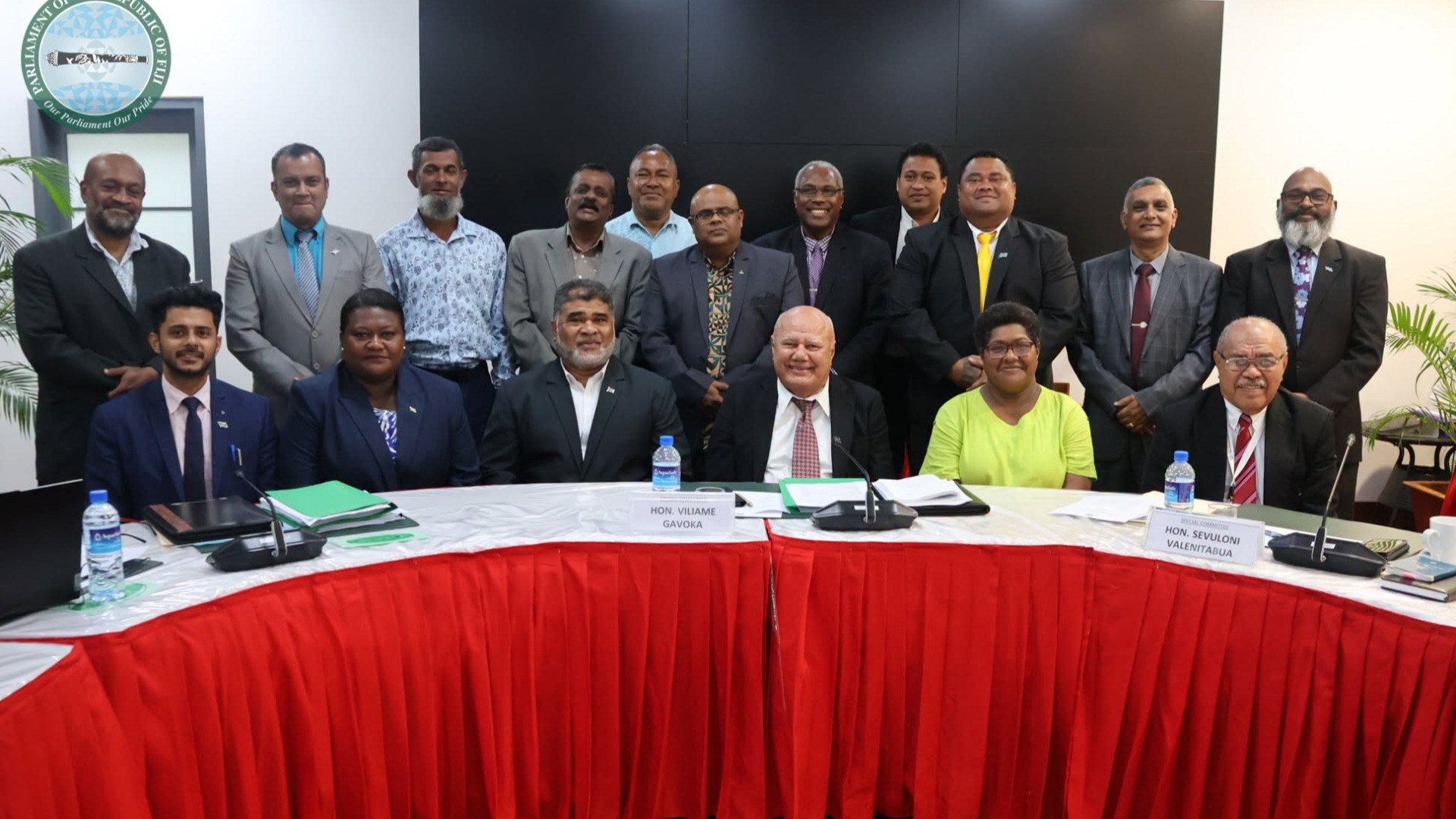
The People First Party is warning against rushing the Constitution Amendment Bill, saying citizens must be given sufficient time to understand the proposed changes and their implications before any decision is made.
Presenting the party's submission to the Parliamentary Special Committee on the Constitution (Amendment) Bill, People First representative Rinesh Sharma says the party deliberately chose not to participate in the Constitution Review Commission process from the beginning because it disputed the correctness and legitimacy of the process.
Sharma stresses that the party's participation in the parliamentary special committee does not mean it supports the Bill.
Sharma warns that rushing the constitutional process could harm the country, saying changing or drafting a Constitution is one of the most important tasks a nation can undertake and should not be treated like ordinary legislation.
Sharma says hurried debates and short deadlines deprive citizens of the time needed to read, understand and discuss the proposed changes.
He says the 150-page Bill, containing 229 clauses and complex legal language, creates a barrier for ordinary citizens trying to understand their rights and how the proposed changes could affect their lives.
Sharma says widespread public awareness, advocacy and civic education programmes must be conducted before any vote takes place.
He says major constitutional changes should be decided through a referendum rather than Parliament having the final say.
Sharma says a referendum would give every eligible voter an equal opportunity to approve or reject changes to the country's supreme law.
He also warns against concentrating power in one person or a small group, saying when people lose their say in how fundamental rules are made, democracy exists only in name.
On the proposed recognition of the Bose Levu Vakaturaga, People First says it respects the traditional chiefly system but believes its role should remain focused on customary and traditional leadership rather than national governance.
The party says governance should remain with democratically elected representatives and that traditional structures should not override democratic principles of equality and inclusive representation.
People First representative Arista Bosei says the appointment of the President should return to the 2013 Constitution, under which the Prime Minister and Leader of the Opposition each nominate a candidate for Parliament to vote on.
He recommends that every political party represented in Parliament should also be allowed to nominate a candidate.
Bosei says the President, as Head of State, must represent all citizens equally, while the BLV represents a single community.
Bosei says restricting presidential nominations to the BLV effectively limits the office to hereditary chiefly ranks, permanently excluding ordinary iTaukei citizens and all other Fijians from aspiring to the nation's highest office on the basis of merit, service and capability.
Opposition MP Sachida Nand challenged the party's interpretation, saying there was no provision in the draft Bill stating that the BLV must appoint someone with chiefly rank as President.
Rinesh Sharma says the party is concerned about possible interpretations arising from what it considers ambiguous provisions in the Bill and believes it is important to consider potential scenarios where provisions are not clearly defined.
Attorney General Sevuloni Valenitabua also questioned the party's interpretation, saying the clause speaks for itself and that it appeared the party was making assumptions about the exclusion of other candidates.
People First strongly opposes the establishment of a Senate, saying Fiji cannot afford the substantial recurring financial burden.
A party representative estimates that establishing a separate institution, including its own Secretary-General, secretariat and administrative structure, would cost between $15 million and $20 million annually.
The party says if the committee nevertheless decides to establish a Senate, its members must be democratically elected rather than appointed.
People First representative Lusia Vusanimasei recommends removing the reference to Christianity and replacing it with either 'God' or 'religion'.
She says the current wording contradicts the constitutional protection of freedom of religion, conscience and belief.
Vusanimasei also recommends retaining Fiji as a secular state rather than changing the heading of clause four to religious liberty.
She says a secular state remains neutral in matters of religion and protects both government institutions and individual beliefs.
However, Valenitabua says the Constitution Review Commission deliberately changed the heading from secular state to religious liberty following submissions received from members of the public.
Valenitabua says there was overwhelming support among citizens who made submissions for the removal of the term secular state.
He says the provisions under clause four remain unchanged and protect the religious rights of every person.
People First also wants Fiji to remain one national constituency under the 2013 electoral system.
The party supports the principle of one person, one vote, one value, saying a single national constituency guarantees equal voting weight, minimises boundary manipulation and reduces wasted votes through proportional representation.
It says the system also encourages political leaders to pursue national unity rather than communal or regional politics.
Valenitabua questioned the party's position, saying submissions to the Constitution Review Commission had shown strong interest in constituency-based representation so people would know who their representatives are.
Sharma maintained the party's position, saying it supports retaining the existing system and had come before the committee to present its recommendations for consideration.
Valenitabua explains that the heading was changed because the term secular state had attracted objections from some members of the public, particularly iTaukei citizens, and the change does not affect the substance of the religious liberty provisions.
People First representative Mohammed Saiyaz Khan calls for the removal of the provision allowing lawful and moderate chastisement for the purposes of correction.
The party also supports retaining Fijian as the national identity while their representative Virendra Lal says the party supports retaining the national identity under clause six.
Party member Hazrat Ali says the party also supports equal citizenship, maintaining that every citizen should be treated equally regardless of race, religion or ethnicity.
Sharma also calls for stronger constitutional protection to ensure freehold land remains freehold land under future governments.
The party also recommends including Hindi in clause 52 on group rights, alongside iTaukei and Rotuman languages.
It says Hindi is already formally recognised under other constitutional provisions, including a requirement for it to be taught as a compulsory subject in primary schools.
People First is also calling for a stronger role for the Human Rights and Anti-Discrimination Commission, recommending that it be allowed to challenge potentially unconstitutional actions, assist the courts and scrutinise proposed legislation before it becomes law.
The party recommends removing the position of Vice President, describing it as financially unnecessary and the office would require additional salaries, allowances, an official residence, security and administrative support for what is largely a ceremonial role.
The party says the existing arrangement, under which the Chief Justice acts as President during the President's absence or incapacity, has provided continuity without additional costs.
People First recommends that the size of Cabinet and its associated administrative costs be maintained at a fixed percentage of national revenue.
It says the size of the executive should increase or decrease in proportion to the country's economic performance and available fiscal space.
Acting Chair Viliame Gavoka questioned whether this would restrict the Prime Minister's ability to restructure ministries and portfolios.
Sharma clarified that its concern was the overall operating cost of Cabinet, including the number of ministers and assistant ministers, saying a larger government does not necessarily guarantee greater productivity.
On the appointment of the Attorney General, the party recommends increasing the period without professional misconduct sanctions from eight years to 10 years.
It says this would make the eligibility requirements consistent with those applying to judges under the proposed Constitution.
The party also recommends that the Chief Justice and President of the Court of Appeal be appointed on the advice of the Judicial Services Commission, following consultations with the Prime Minister and Leader of the Opposition.
Sharma also calls for the reinstatement of the Code of Conduct and Accountability and Transparency Commission under the 2013 Constitution.
He says the commission should establish binding ethical standards for the President, Speaker, Deputy Speaker, Prime Minister, Ministers, Members of Parliament, permanent secretaries, members of commissions and other senior public office holders.
Sharma says an independent enforcement body would help prevent conflicts of interest, eliminate political self-policing and strengthen public confidence in public office holders.
They also recommend retaining FICAC as repealing the existing legislation without a fully operational constitutional replacement could affect FICAC's investigative powers, ongoing investigations and court proceedings.
He says FICAC must retain its legal mandate and constitutional standing to prevent a possible gap in the investigation and prosecution of corruption-related matters.
People First also wants the reinstatement of the Transparency and Accountability Commission to monitor conflicts of interest, declarations and potential abuse of public office.
Consultation on the Bill continues as the Special Committee will be at the Tuva Primary School in Nadroga from 10am to midday and from 3pm to 5pm at the Votualevu College Hall in Nadi tomorrow.
